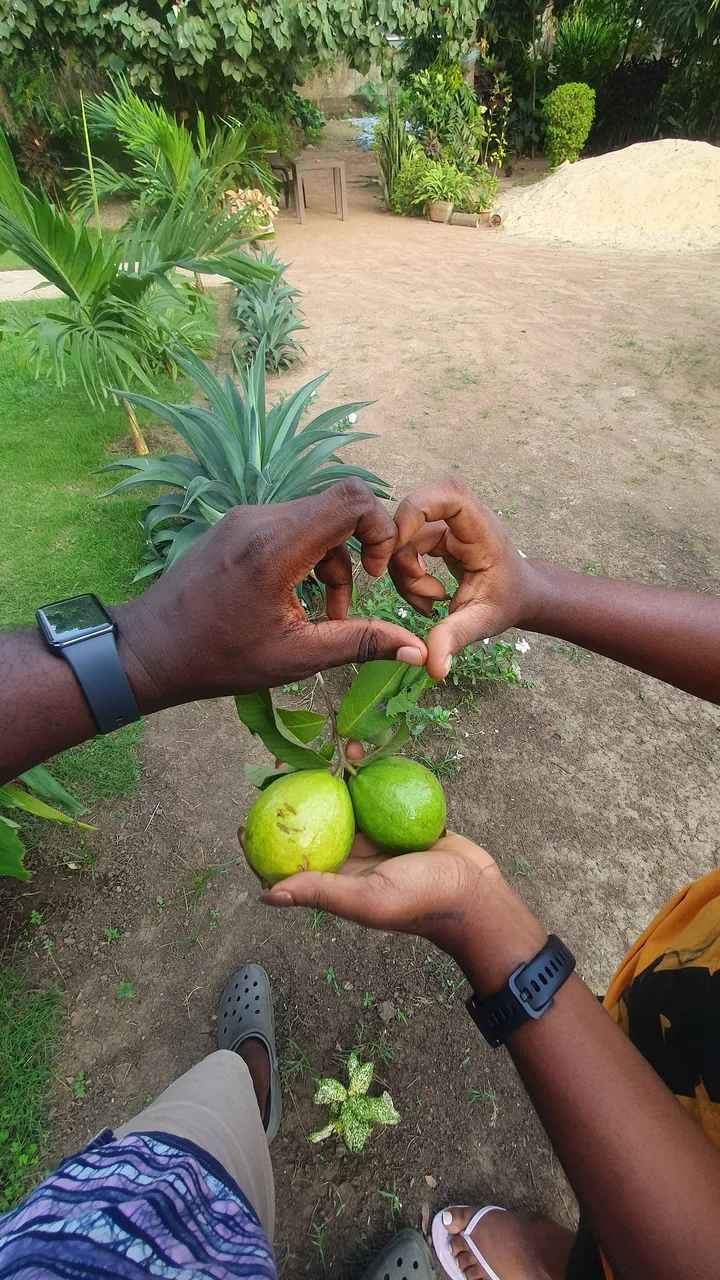
Tour Editorial · 4 October 2026
The Lagos Farm Reclaiming Food and Quiet in the City
A conversation with Our Grandma’s Farm
By Tour Editorial and Soala12 minute read
Saturday morning, we drove up to Agege to visit a farm. “Drove” is perhaps an understatement, it was a road trip. ‘‘A road trip to Agege to visit a farm’’ was not the easiest case to make to my friends, but there we were.
I heard of Our Grandma’s Farm for the first time in July, from a farmer’s market they took part in at Suudu. The name alone made me curious. We reached out and were invited to a “Ferns & Farm-ily” gathering at the farm that Saturday, a potluck, barbecue, games, a farm tour, and some yoga.
After a long journey of missed turns and passers-by directions, we arrived at the gate. Let’s mark this moment here, Jaiye, father of the farm, emerging through the gates like a guardian spirit to greet us, bright smile, wearing a white tee with a name tag, shorts, and a safari hat, as the start of what turned into a lovely, familial day.
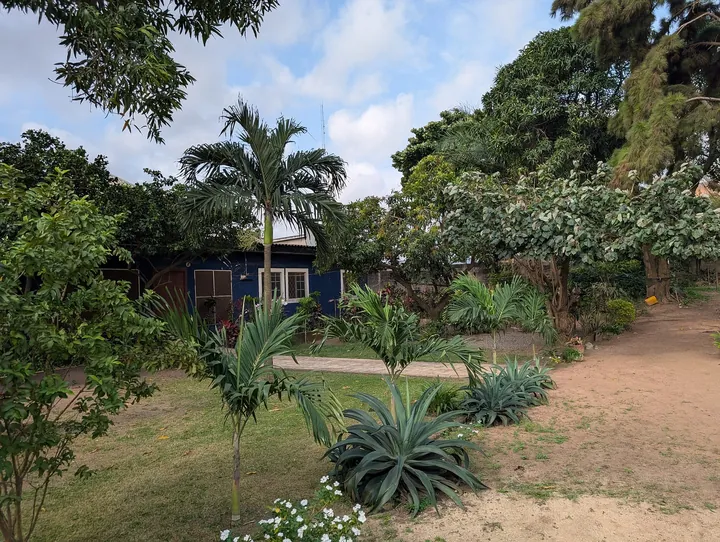
Moving around Lagos, one is usually starved of trees. OGF is about two acres, anchored by two bungalows set at right angles to each other, with a garden between them. Around them stretches a wide arc of open space. We sat under the mango trees, where the ground had been filled with stones topped with plastic tables and chairs. It was a lovely day.
After applying mosquito repellent and our name tags, we sat around the tables for introductions. What’s your name? How did you hear about the farm? Most of us were friends of friends, or friends of Jaiye, so by extension, friends of each other. Jaiye went last, introduced the farm, welcomed us, and spoke of the inexpressible joy of eating mangoes achieved from the trees above us, in season.
Then, the tour. My friend and I swapped our jeans for shorts first. We started on the right wing, walking carefully so as not to trample the crops, though walking through was actually encouraged, since it helped wear in the footpaths. Rows of garden beds held cabbages in bloom, young ginger shoots, and red peppers we tasted straight off the plant, green just the day before. They’d done so well recently that Jaiye had planted more. We learned that “vegetable” is really a culinary term, what we actually eat are roots, stems, leaves, and fruits. Okra, for instance, is a fruit. Carrots are roots. The tomatoes on that wing weren’t doing so well, likely pests, though the basil nearby had kept the peppers safe.
On the other wing, we saw red okra for the first time, passed around fresh basil and lemongrass to smell, and walked past plantain trees, bell peppers, cherry tomatoes, ewedu, ugu, mint, and more cabbage beds. The mint, lemongrass, and sweet potatoes, now growing in abundance, had all been propagated from just a handful of cuttings months earlier.
As we walked, Jaiye talked through his approach to farming. Pre-harvest losses can be significant with organic methods, he said, but he’d rather work through that than default to convention, organic farming, to him, isn’t a question of whether to use chemicals, but which ones. He’s hoping to eventually incorporate vertical and soilless growing, and has deliberately avoided building multiple greenhouses, since the goal is for the farm to function as one large, thriving ecosystem rather than a factory. Long-term, he wants OGF to operate as a market garden, where people can book their own harvests. Some nearby construction had given him bamboo, which he was eyeing for furniture, maybe a swing set. This whole journey, he joked, had turned him into a carpenter too.
After the tour, a few of us threw sweet potatoes from the farm onto the grill alongside some ribs, and passed around tea made from the farm’s own lemongrass. It was evening by the time Jaiye and I sat down for this conversation, by the garden, just as the sun was setting, the hour, he explained, when the marvel-of-peru flowers bloom pink.
Does this land belong to your grandmother?
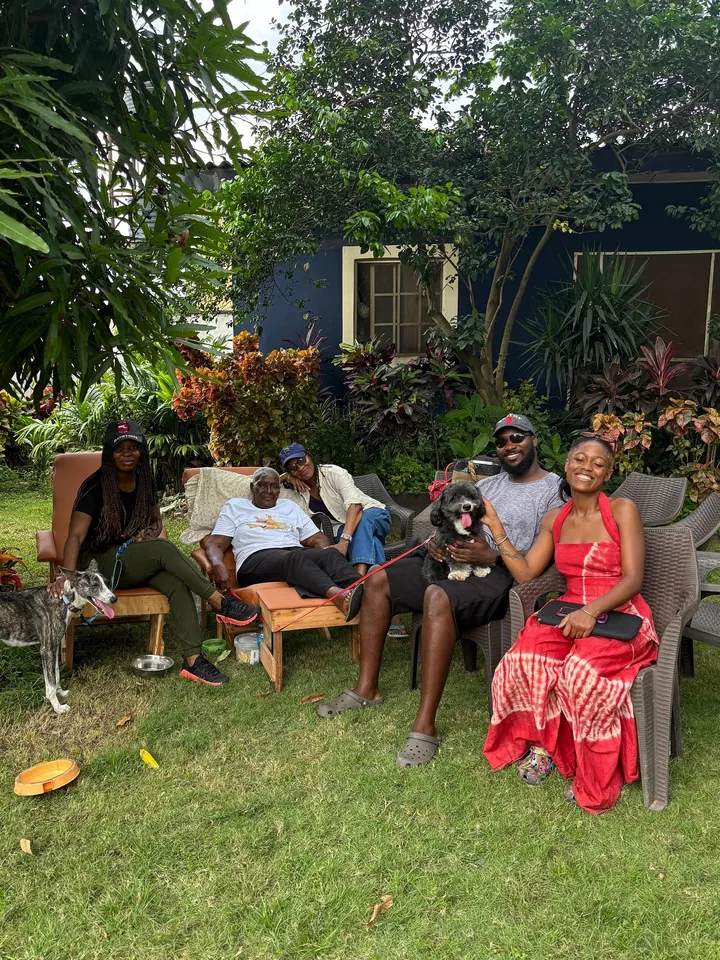
Jaiye: This is my grandmother’s land.
Can you tell us the story of how it came to be?
Jaiye: Much like a lot of land in Lagos back then, it was inherited from her father Chief Imam Lawal Basil Agusto. He was a Queen’s Counsel lawyer. Before that, he was a pharmacist, and his father was actually a farmer. He didn’t farm this land, he acquired it during his lifetime, over 60 to 80 years ago, if not longer, and it was a functional farm over 100 years ago.
I just want to keep the farm alive. At one point, there were hectares and hectares of cocoa farms in Lagos’s agricultural history. Though this area is still zoned for agriculture, you don’t really see much direct agriculture now. You see a lot of estates and urbanization, which is great. It shows that the arrow of time is moving in the right direction.
‘‘Inspired by our grandmother’s legacy of self-sufficiency and community’’
Jaiye: My grandmother is a feminist icon, truly. She’s a resilient woman, and at her age, being able to take care of herself, have things in her own name, and work the career that she did is very inspiring. Being able to sustain herself in her old age, especially in Nigeria, where pensioners often didn’t get their pension, is truly remarkable. She’s lived a good life, and to be surrounded by plants, I think that’s always a good sign.
‘‘Pharm to Farm.’’ Talk me through how pharmacy parallels farming.
Jaiye: With pharmacy, there’s definitely attention to detail and caregiving. You’re giving care to people, and now I’m giving care to plants. I love health, and I always want to help people. When I came to farming, it wasn’t so much that I left health, it was that I went deeper into it. When you go to your doctor, what do they tell you first? Eat healthy, exercise, get fresh air. I’m coming to the source by growing nutritious food.
What we do when we’re growing is first look at whether something is actually healthy, I won’t grow it otherwise. We grow lettuce, fresh greens, and orange-fleshed sweet potatoes that are very high in Vitamin A. Vitamin A deficiency is a major problem in Nigeria, especially in early childhood, so that’s another reason we chose that variety, you can get your whole daily requirement from it. It’s great for babies and mothers, and it tastes delicious too.
Does anything else from your pharmacy training show up in your work?
Jaiye: The attention to detail, the record-keeping, treating each plant almost like a patient: “Okay, it needs more nutrients here, this is the treatment, we need a regimen of supplements.” It really does carry over, even just the mindset that making sure someone has a nutritious life starts with food. But I would never have thought I’d end up in farming.
Tell me how that journey started.
Jaiye: It came from a switch I made at a point from health to finance. I thought about what I really wanted to be doing, and I still wanted to help people, but I looked at my biggest cost, food. I thought, if I have my own food sorted and know my food bill, I can be freer to pursue my passions, so I started growing food at home. Then the more I learned, the more I realized I could make a good living from it.
I looked around and saw people not eating healthy. My mom and grandmother complaining about how food is different now, adulterated palm oil, plantain sprayed with who knows what, pesticides on greens. It’s all crazy.
Before, we’d occasionally harvest something, nothing close to the quantities we get now, and I wasn’t very involved. There wasn’t even water for it, but they made do with what they had. When I started paying attention, I realized it needed someone to look after it, care for it, love it, and go through the pain, because farming is painful. I love it, and you can’t do it unless you do. If you’re just looking for money, it’s not the way to go, because at any point it would be very easy to say, “Let’s go meet a developer.” But that’s what I’m fighting against. I’m showing that an urban farm in Lagos can be a sustainable, profitable model for agriculture.
What was this space like when you were younger?
Jaiye: Five years ago, when I first moved back to Lagos, it was mostly bush. That whole raised garden area was all bush. My grandmother carved this space out, so I’m just carrying on from the garden she built, and building a working farm around it. I do this for my grandmother, truly.
I have a dream of this place working so well that food sustainability is real here, that you can come and say, “I’m eating off the land today.” It’s wild that we just pulled sweet potatoes out of the ground, threw them on a fire, grilled them, and ate them, and they tasted delicious. We can make ewedu anytime, okra anytime, ugu anytime. We’ll have a pond at some point too, a pretty one, with lily pads and fish.
Do you plan to have animals at some point?
Jaiye: At a small scale, and it’ll be a community vote on which animals we keep. We’re doing four animals total. We’ll have a beehive in the corner of the farm for fresh honey and beeswax, plus fish. For the other two spots, we’ll ask the community: do you guys want to get to know a goat very well, or birds, or rabbits?
Speaking of animals, how are Plato and Aristotle?
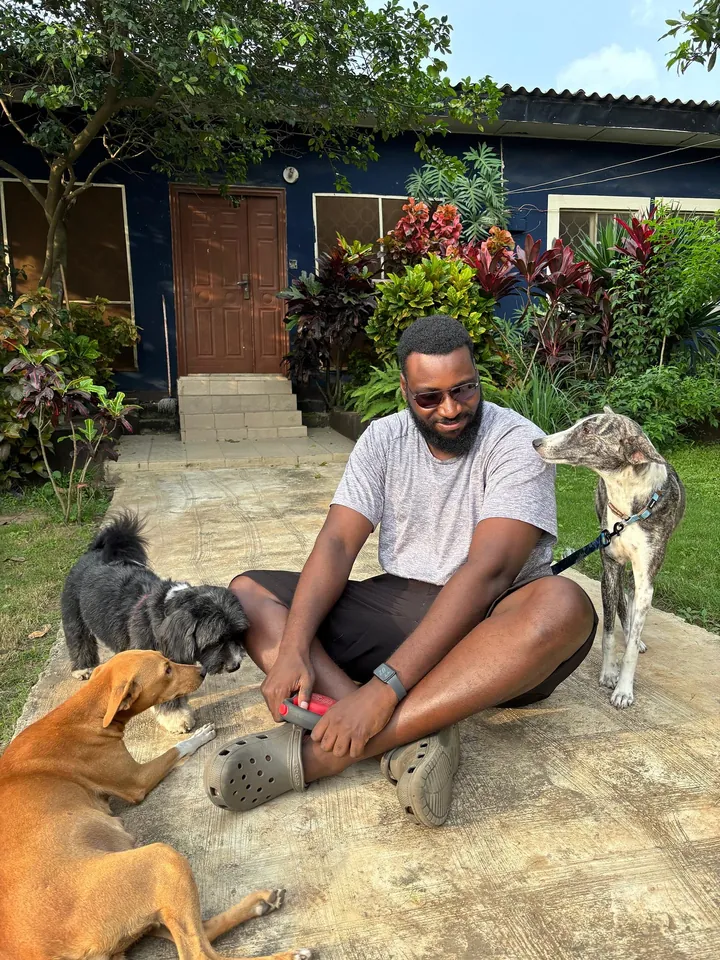
Jaiye: You can catch them here sometimes. My grandmother’s dogs, our dogs really, it’s a joint venture. We named them after two philosophers whose core thesis is about living a good life: appreciating your friends, your time with family, and striving to be good. That aligns with how I live too, bringing people together to enjoy themselves, have good conversation, and talk about nonsense sometimes too, because that gives us space to be creative with language without taking everything so seriously.
“Farming in a way that leaves the soil healthier than we found it.”
Tell us about your soil-building practices.
Jaiye: I’m trying to build my soil, which means being conscious about how and what I plant. A lot of large-scale machine agriculture isn’t regenerative. People plant the same crop in the same spot over and over, and if you’re using GMO seeds, that’s not good either. In our crop cycle, we plant things like nitrogen-fixing peas to take care of the soil.
We also keep compost pits. We ask community members to bring their vegetable waste and kitchen scraps so everyone participates in building rich soil. If you buy sweet potatoes or cabbage and throw away the scraps and skins, they go back in, it’s a small thing, but it gets people thinking more eco-consciously.
Agriculture globally is in a scary place, and we need more regenerative practices and more smallholder farms adopting them. Industrial farms grow commodities, crops tied to currency, whereas small farms like this can do so much with limited space. So much can be done with half an acre. Again, I’m a baby farmer, no expert, just a farmer.
Does that philosophy connect back to the community you’re building here?
Jaiye: Yeah, I think everyone here comes from a diverse background, but we’re all trying to live a good life and excel in our own way, small business owners, people in corporates, artists. I think especially the artists and creators need somewhere to draw inspiration from, and I hope to be one of those places. I want this to be somewhere artists come to be inspired, or even host exhibitions, small gatherings, and intimate concerts for 60 to 80 people.
What are your plans for reimagining what this place will look like long term?
Jaiye: I imagine a space people can visit for concerts or classes during the week, book clubs, adult literacy lessons, music lessons, agricultural programs for schools, and hosting events like wedding receptions, introductions, and pop-up restaurants when a chef wants to try something different. Right now, we’re using less than 40% of the space total.
Can you describe how this feels as a “third space” compared to the rest of Lagos?
Jaiye: You forget you’re in Lagos. You hear the birds. The air is different. You get away from the hustle and bustle, there’s more variety of food than you’d ever imagine. It feels like a time capsule, almost a Lagos I never actually met. I’m trying to recreate a past I never saw.
What’s in the future for Ferns & Farm-ily?
Jaiye: Friends and family, I’m imagining people who inspire each other. Friends who agree with the vision of reconnecting with our food, our agriculture, our land. The farm isn’t static or old, it’s organic. Even the way it’s been funded and built, it’s trying to pay for itself and become self-sufficient.
I hope eventually there’ll be seasons when it’s open to corporations for retreats, and to others who want to come do a pop-up. My friends want to come do a sit-down menu straight from the farm, or adopt our harvest and say, “Come eat with us.” I want the love to spread. When we start doing short stays, people can stay here with us.
I think it’s especially important because some of us just don’t have access to green space in Lagos. I’m lucky, I grew up around it. I want my friends to come, and my grandma loves seeing young people use the space.
And the yoga, how did that start?
Jaiye: Our friends asked, “Can we do yoga here?” because the air is different. Sunrise yoga, really fun, sometimes led by community members. I think we’ll open it to the public soon, with limited tickets, as a kind of welcome to the farm, with fresh lemongrass tea.
I never got to try the tea.
Jaiye: Oh, you have to. We have a lot of it! It’s awesome that it’s on our list of top plants, because people are always like, “Oh, they want it.” It’s been growing really nicely, and honestly, I can’t give enough of the story behind that lemongrass.
Every lemongrass plant you see here started from just one. We took care of it, divided it, and kept doing that over and over. Instead of buying a hundred lemongrass plants, we grew a hundred from one, dividing it in half, again and again, moving cuttings around the farm. We’re being intentional about it, going organic. It also repels mosquitoes, so people are more comfortable here too.
Can you tell readers what you grow here?
Jaiye: Oh, listen up. We grow healthy, tasty things, don’t sleep on microgreens. We have about six varieties, including rambo radish, pea shoots, nasturtium, and broccoli, those are my personal favourites. Fun fact: microgreens have about four times more nutrients than full-grown broccoli. We also grow arugula, lettuce, and some staples that’ll be available for sale soon. Ugwu is one that keeps on giving, Edikikong is my grandmother’s favourite soup, and honestly, I love it too.
I love Edikikong. It’s funny, in Port Harcourt Ugwu leaves are everywhere, but I barely see it in Lagos.
Jaiye: We had a great harvest this year, and six pods to end it with, which was exciting, but I don’t think I’ll keep growing it here at scale. The market really is our kitchen. If I grow extra at home, I’m happy to add it in. I like that my crop list won’t be the same from year to year, it’ll change with the seasons. Some things I’ll stop growing, others I’ll pick up. What I plan to do is send seedlings to regular customers: “It’s your turn to grow, and I expect some back.”
I hope the community comes around to it, it takes time, and I won’t sell what I don’t actually have yet. I want to make money, but I want people to talk to me first. Right now, if I have a harvest, I’ll just ask who wants some. But eventually, in the future I’m building toward, I’ll know exactly who eats my produce, and they’ll know exactly where it came from. That traceability matters. Most of us don’t know where our food actually comes from, and having a name and a face behind it, someone you can ask questions to, is essential. Farming has made me healthier too, it’s changed how I cook and eat.
What do you hope people walk away with?
Jaiye: Joy, peace, and a desire to come back. Honestly, we can do anything here. I love hearing what people want to try, there are so many possibilities in this place.
Thank you for talking to us, I was really excited to come here.
Jaiye: Thanks for having us.
Interviewed & written by Soala Iyalla