Tour Editorial · 27 December 2025
Who is Lagos for?
As usual, we’ve created something vibrant and beautiful with our hands. As usual, the locals are being excluded.
By Tour Editorial7 minute read
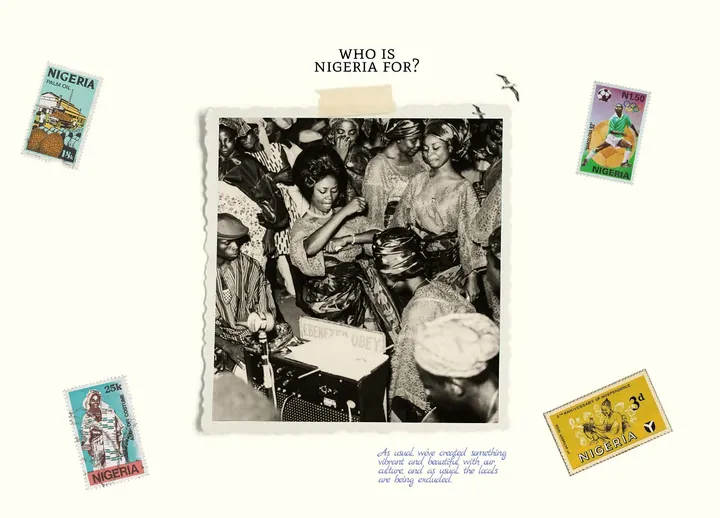
To the birth of our Bethlehemian baby of interest this month, we owe many things:
The countless visits to aunts, uncles, grandmas, grandpas, and family friends; the constant sinking into another couch, another living room; the procession of women coming out of kitchens with trays of glowing red rice; the church services on Christmas mornings; the carols; the poorly done plays and the protesting babies forced to play our mangered lord and saviour; the prayers—thanks to God for sustainings and keepings and not allowings; the new clothes and matching outfits; the presents and uninspired company hampers; the music up and down the streets; Boney M dancing maybe too erotically on TV screens.
The shopping and the weddings; the beaches and amusement parks. And the lights: pearls scattered at night across the city. And the harmattan that blows through empty classrooms in lonely schools; that blows through fluttering greetings in the air; that blows through the oversized suits and dresses of children posing stiffly for family pictures. And yet another thing: rest.
December always brings a feeling of finality. Unlike the summer holidays in France and Spain, or Ferragosto in Italy, the Nigerian year is a long, sun-drenched trek, save for a few public holidays. A trek that is relentless but finally eases in December (for most people, at least). The year dissolves into a peaceful evening as the harmattan arrives from a long journey of its own.
The movement heightens as people start to travel home: many to their villages to see loved ones and rest from the city; some go abroad; and some—the sojourners of heightened interest these days, the IJGBs—come back home. Houses silent all year are suddenly filled with the voices of children and adults away for school or work. And the houses once full of activity go quiet again.
But beyond the beaches and the shopping and the overworked maids, December is also, especially amongst the young, about the live performances. Music and dance, and the flourishes we place around them are an inseparable part of the texture of Nigerian life. They bleed through everything we do: weddings and traditional marriages, rituals, birthdays, child dedications, praise and worship—even funerals. And bleeding into popular culture, they took the shape we know today: from the Afro-jazz, Highlife, and pop of the 80s and 90s, to the Lekki Sunsplash festival in the late 90s, to the emergence of Afrobeats in the 2000s. It has remained a way for us to escape and express.
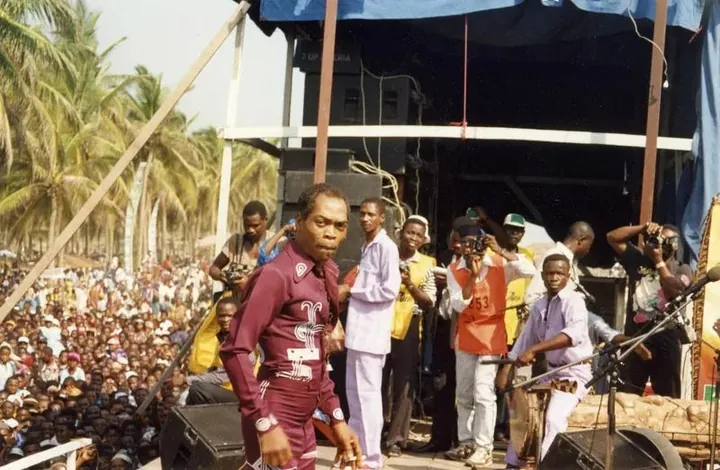
Where we are today with Nigerian music is a place I don’t think anyone would have predicted 30 years ago. Afrobeats now houses some of the biggest artists in the world. Billions in streams and tickets sold, foreign labels and companies setting up shop in Lagos, pop artists scrambling to feature and get featured. Yes, it is something to be proud of, especially in relation to how we’ve perceived ourselves in the foreign eye, where we’ve been led to believe we make no meaningful contributions to the world.
The buzz around our music was bound to erupt; it’s almost inherent to the way we express ourselves, to the texture of the music itself. Throughout the 2010s, from D’banj to Wizkid to Olamide’s myriad of dances, big as it all was, it always felt like an isolated buzz. I remember it used to be a big deal when Nigerian artists got any sort of international cosign, like when Wizkid linked with Drake for “One dance” and “Come Closer” (Davido fans were down bad). I first noticed the air shift in 2018 with Burna boy’s “On the Low,” and then, suddenly, the floodgates opened.
Over the past decade, this particular mix of music and festive celebration has created a multibillion-naira industry, especially around Nigeria’s cultural epicenter, Lagos. Every facet of December festivities has been infected with a craze. And as the country gets poorer—the world, even—the celebrations seem to get bigger, more inflated. Entertainment, hospitality, retail: food, clothes, parties, concerts, everything booms.
The international eye, ever watching, ever present, has fixed its gaze on Nigeria once again. The past few years I’ve seen artists I never thought I’d see on African soil, let alone in Nigeria, perform in Lagos—from streamers like Kai Cenat to J. Cole, Migos, Gunna. I just saw a poster for Rick Ross. Every other day we’re met with another “Lagos I’m inside you” tweet. There’s a very intentional force behind this enlarging carnival of ours.
And great as it all is—as beautiful as inclusion and exposure and enjoyment can be, the money pouring in and people of all sorts—it’s hard not to notice the contrast between the state of the celebrations and the people on whose backs this entire culture has been built. As usual, we’ve created something vibrant and beautiful with our hands. As usual, the locals are being excluded.
Whose December?
Our beloved Jesus's birthday (appreciated as he is) is foreign to us, culturally speaking. One custom among the infinitude of treasures we received from philanthropic Europeans. But by the late 1990s, all the commercial features of what we've come to know, and more recently, dread, about Christmas in Nigeria were already plastered in public consciousness.
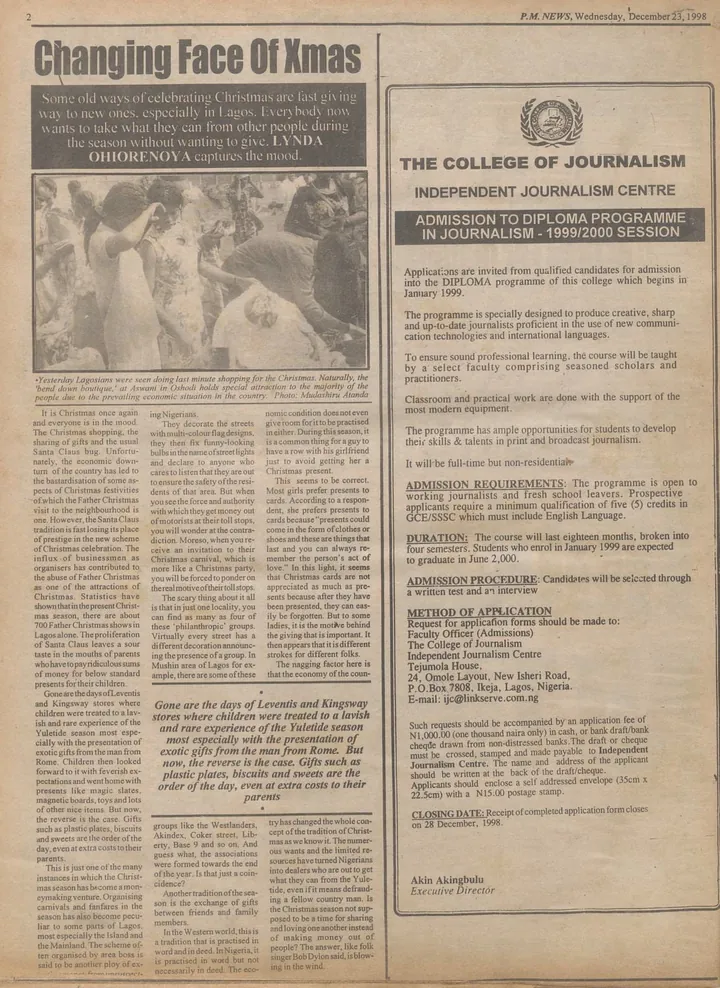
Christmas—love and family and rest aside—was becoming the hot spot in the year when certain businesses could feast on Christmas enjoyers like bears on salmon runs. The Western model was taking shape. And alongside the merry and cheers was a growing capitalist appetite. Price hikes. Rushes among the sellers of shoes and clothes and gifts, the sellers of trees and decorations, the sellers, the sellers, the sellers—and in even greater intensity, the downpour of buyers.
By the time I was growing up, the circus was in full operation. Sponsors! Sponsors! Sponsors! Five gifts to give your husband this Christmas! Flash sales! This Christmas donation brought to you by Okeke & Sons and Bournvita! The radio jingles, the newspaper ads, the billboards and promos.
And it was always interesting how people experienced all of this differently based on their class—the very joy of the birth of our lord and saviour. So hedonistic, so much to buy, so much to have. And yes, I know: it's "a part of life" to wear the shoe that fits. But Nigeria has a special talent for taking the little you have. To quote our mangered lord and saviour on this harsh truth: "To everyone who has, more will be given, and they will have an abundance, but from the one who has not, even what they have will be taken away."
The year is 2025—maybe the worst year I’ve seen in my short lifetime. An almost lynchian arrangement of political and economical affairs in an already absurd country. Our dewy-eyed chief of state arrived in 2023 in all his radiant beauty, and brought with him the worst inflation surges recorded in our history. More and more people roam through cities, whispering for money to anyone who will hear, sleeping in the streets. The roads flood with young men on food delivery bikes. Every face you watch pass by—whether by car, weary on foot or bicycle, or cramped in a danfo in tight traffic—is contorted with stress. It’s been a beautiful year. And as if the elements wanted to join in on the fun, our already-merciless West African sun came down in significant heatwaves, mean-mugging us like Patience Ozokwor.
Finally, the month of easing has arrived but something is amiss. In fact, it seems the stress is reaching a crescendo. For some reason, it's hot. By the end of November, the roads were already frustratingly congested. Uber prices quadripled. And against all this stress, there’s an overflow of concert posters looming about; there’s luxury cars driving up and down the streets; there’s lines of drivers asleep in cars outside exclusive clubs and restaurants; there’s IJGB babes recording suya men like endangered species.
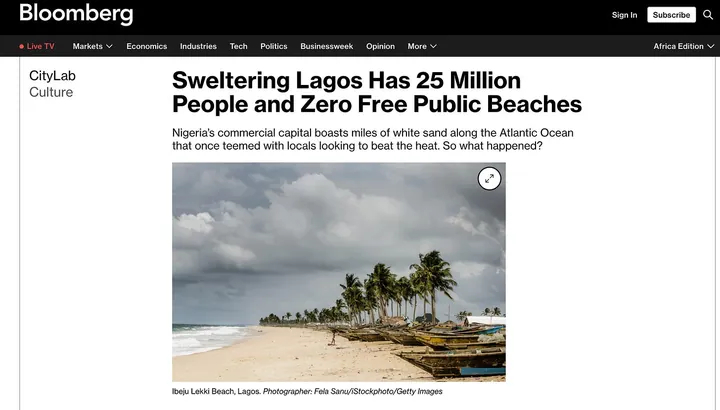
With all this influx of tourism and foreign spenders, all this cultural currency, somehow the government (and the “Detty December Committee”) is more interested in revenue than the city's capacity to accommodate the influx. All of a sudden we're charging $300 for single-entry 90-day tourist visas. Ticket prices have spiked. Hotels and shortlets are charging New York real estate prices. Everybody has caught the craze: hairdressers, concert promoters, drivers. Even the beaches that used to be places of enjoyment are now privatised—miles and miles of coastline walled off. How is it that a city on the West African coast has no free beaches for locals to enjoy? An almost-ordained geographical pleasure, and its inhabitants are being priced out. And to flourish it all, NEPA is misbehaving.
So if the average Lagosian cannot afford the beach, or the restaurants, or to explore their own city at a fair price and in sane traffic, or to see their favourite artists, or even to have light in the comfort of their homes—who exactly is all this for? This inflated carnival, this city? Of course, the golden rule of this model is greed. This is the state of affairs it encourages; it’s inherent. And Nigerians have shown time and time again that we will sell anything for any price to colonial-esque tourists or to the ultra-rich among us, neither of whom have intentions that include the people.
It's important we don't lose ourselves in the name of tourism. But on the other hand, maybe we were never ours to lose. I'm worried we've stretched ourselves too thin, tinged too far. I'm worried about a people whose year no longer dissolves or ends, but just bleeds into another long trek. How long can we keep this thing moving?