Tour Editorial · 16 October 2026
Nobody Watches Quietly: This film club is starting New conversations
An interview with The Screen in Transit
By Tour Editorial and Soala19 minute read
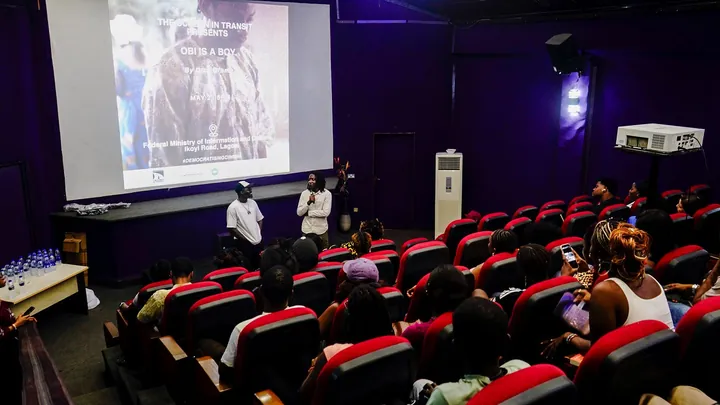
In August I went to a film screening by The Screen in Transit at the Nigerian Film Corporation Lagos Cineplex in Ikoyi, Lagos. It was evening, and I was ushered up through the orange building to the door of a dark cinema where the first film of the night, Nii Kwate Owoo’s You Hide Me, was just ending. I showed my free ticket at the door and went in.
The lights came on soon after I sat, and Ife, one of the curators, came to the front of the hall, mic in hand, and spoke briefly about the short film. A few questions from the audience followed, some of which he deferred to after the next film, and the lights faded out again. It was Mati Diop’s Dahomey.
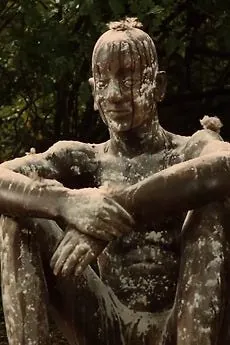
The dramatised documentary follows the return of twenty-six out of the thousands of treasures looted from the kingdom of Dahomey, now present-day Benin Republic, by French colonial troops in 1892. A wooden statue of King Ghezo, who ruled Dahomey from 1818 to 1859, now object 26, narrates the film through an internal monologue spoken in Fon. We watch as he and his counterparts are sealed in wooden boxes and shipped back home to be put on display at a museum, presented with a fear not so different from 130 years ago: he is now alien to his own home and people.
An open debate amongst a gathering of young Beninese citizens takes place after the return of the artifacts. “Did you know that a thousand Beninese artifacts were held overseas? If so, at what point in your life did you find this out?” Arguments are made, and people cheer or applaud in agreement. “In high school we were told ‘a lot of things were stolen from us,’ we were told these were things, not knowing they were treasures.”
One man says it is an insult that only 26 have been returned out of thousands. Diane, a filmmaker, rebuts: they should be grateful for the 26 they got. Another lady believes the whole thing is a political show, meant to give President Talon, Macron, and ultimately France, a favourable look.
And, perhaps my favourite statement in the whole debate: “We were told by our parents that things were stolen from us, our able-bodied men went away, and they sidetracked us by putting in a system of education, facts that don’t engage us in any way, and curiously sucked out our capacity for excellence.”
When the lights came back on, Ife once again returned to the front and spoke about the film, then opened the floor to discussion. One guy in the front row was a little annoyed with Diop’s style, especially in the first leg of the film. It reminded him of arthouse films, and he wished she’d get to the point sooner. The lady to my right gently pushed back. She spoke of Diop’s slow lingering as a technique to evoke more meaning out of the objects she’s focused on. She pointed out parallels between 26’s POV in the dark wooden box, being shipped, and what it might have felt like to be enslaved and transported the same way. She also raised Frantz Fanon’s Black Skin, White Masks, and the idea that we don’t need a cultural history to justify that we are people worthy of dignity. A boy behind us said that not knowing his native tongue, Igbo, meant he was shut off from an entire world available to his mother. A girl in front spoke of the value of these works beyond any aesthetics. Sacred art is sacred first, and then art.
The Nigerian Film Corporation Lagos Cineplex, where this stimulating conversation was happening, sits in the same compound as the abandoned building of the British Colonial Film Unit. It was a unit tasked with Britain’s imperial visual propaganda, headed by a man named William Sellers, whose style of colonial filmmaking, as filmmaker Onyeka Igwe discovered, was built on the belief that colonial subjects could not be cine-literate because of deficiencies in intelligence and the physical structure of their eyes.
That film unit’s main tool for reaching people outside the major cities was a network of sub-units that toured the country in mobile cinemas. They moved through both urban and rural areas showing colonial films and newsreels shaped by the British government’s priorities, with some screenings having live translations into local languages.
It’s invaluable, then, that a community like The Screen in Transit is using that very medium today to nurture the kind of conversations and education I experienced that evening, and in a growing list of cities across Nigeria. In the days after that screening, I had the following conversation with its lead curators: Ifeoluwa Olutayo, Amanda Madumere, Rete Poki, and Zainab Umar.
How does a screening with The Screen in Transit usually go?
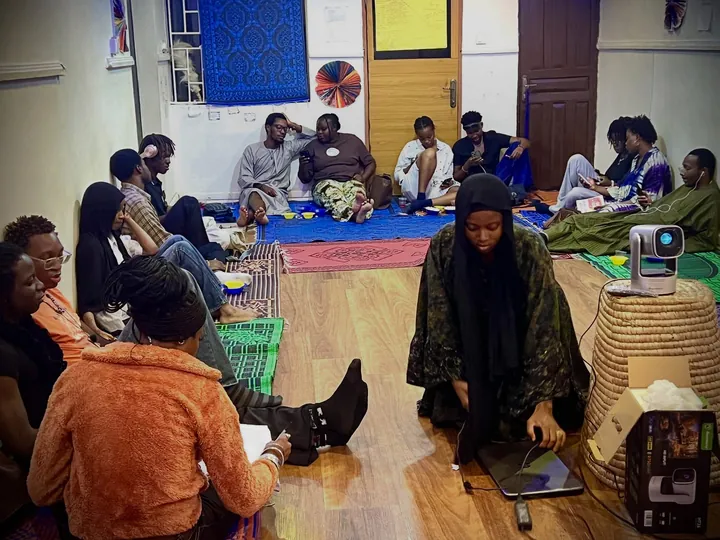
Rete: In Abuja, we usually start around 5:00, 5:30. We’re not in a proper cinema like in Lagos so it’s more like a home video setting, quite literally a flat. We have everybody sitting on mats, backs against the wall, facing the big screen. We come in and usually start with an intro: a brief overview of the films, the theme we’ve selected, and what The Screen in Transit is, our mission. If we have a partner, we introduce the partner and the guest curator. Then we start with the shorts. Usually after the short we have a short conversation about the film itself, and we like to go across and have everybody introduce themselves. The whole idea is that it’s meant to be an interactive experience: everybody has to give the movie a rating out of 10, and you can’t say five. You can say zero, you can say 10, or you just need to explain what you liked or didn’t like about it. It encourages people to engage with it on a personal level.
As people are doing that, you’d have back and forth across people. Someone might completely disagree, another person might completely agree. It opens up the space for everybody. I guess the ultimate goal is to feel like you’re watching movies with friends, like when I was younger, sleepovers with cousins and everybody would come. Really nice to create that environment.
Ife: For Lagos, usually we have to coordinate with the guys at the Nigerian Film Corporation Lagos Cineplex. We get in around 3:00 p.m., set up, test the films, sound, visuals. We start with an intro explaining who we are and introduce the theme for the month. We show the short film first, and if it’s by a contemporary Nigerian filmmaker, we ask their presence to answer questions in a Q&A. Then we show the feature, and afterwards we have a conversation about the theme and whatever else developed while watching. If there are 50 people in the audience, they watched 50 different films through their own unique lens, so we leave space for people to ask questions and explore their own perspectives.
How did you all meet?
Ife: In May 2024, Amanda and I attended a month-long national cinemas program at Treehouse, Ikoyi. I actually wrote an essay about Sudanese cinema off the back of that program. We spent an enjoyable time just exploring what those films meant, the politics around why they weren’t being shown, the country’s constant turmoil. Afterward, Amanda, myself, and some friends shared a ride heading back to the mainland. We were talking about how these alternative cinema spaces were disappearing and how necessary it was to create more spaces like this to fill the gap.
Amanda and I continued the conversation. She mentioned we could use her living room and that her workplace was getting a projector. Then in August 2024, while in Abuja talking with my friend at a space called The Living Room, the owner overheard our idea and invited us to do it in Abuja too, for free. We reached out to Zainab and Rete to build it with us, and in November 2024 we held our first concurrent screenings in Lagos, in Amanda’s living room, and Abuja, at The Living Room.
Amanda: I met everyone through Ife, actually. The first time I met Ife, he had just gotten a grant from Goethe-Institut to make a film, I think it was during one of our Post Memory, Post Archive sessions.
Ife: How I met Rete was in November 2022, when a short film I’d made with my friend GZY showed for the first time ever, anywhere, in Lagos. It premiered alongside Jimi Agboola’s second film, and Rete walked up to me afterward and told me he loved my writing, that we should work on something. That led to us making a film together the following year called All the Places I Once Loved You, my second short, and I think his third.
Rete: Me and Ife met, I think, in 2022. I’d just moved to Lagos for NYSC and I came to a small, really small screening, similar concept: screening one of his short films, Canvas, and I thought it was really cool. I was a filmmaker as well, so I hit him up. We had a conversation after. By the end of that year we’d made a film together called All the Places I Once Loved You, and a few years later we had the conversation about what do we do with our movies after making them. That came out of a really small screening at Treehouse in Lagos. I really rocked with that, and the idea of being able to meet new people and engage with movies that way.
Zainab: Ife had been following me on Twitter, and so he reached out to me to have a meeting, and I was in law school then. So I found time to meet him when he was in Abuja, and then he spoke about possibly starting The Screen in Transit. Later in 2024, he arranged another meeting with me and Rete, and we met with the people that run the space. We had our first screening November 2024 for Abuja. I believe they also had theirs in Lagos as well. I have never met Amanda, I hope to soon.
The first screenings in Lagos were in Amanda’s living room, and in Abuja, a flat. Is that kind of intimacy important to the vision?
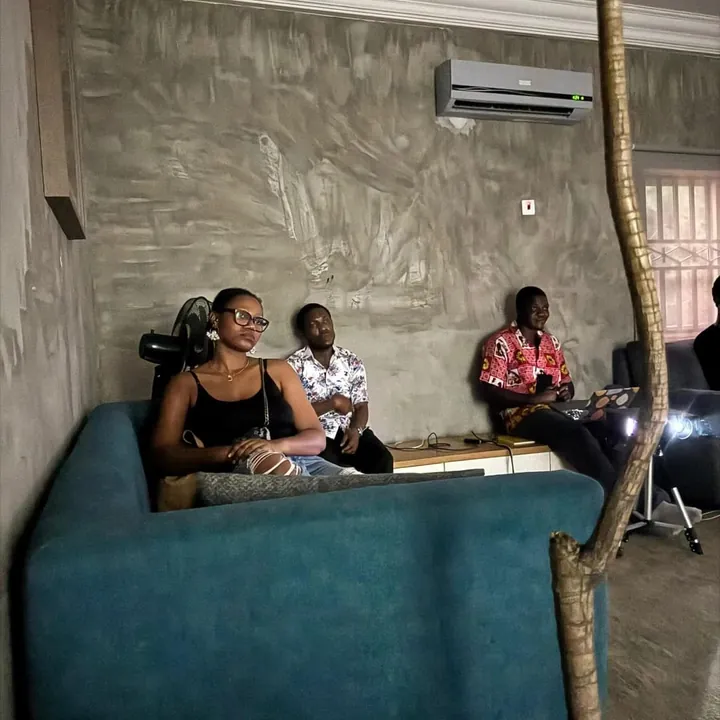
Ife: Initially, the consideration was just to provide a space where people could talk about films critically and see films they wouldn’t see anywhere else, costing little to no money, because we were funding this out of pocket. Amanda used to remind me early on that we had to find support as quickly as possible, because even if it was “little money,” it was still money we were spending, and that wasn’t sustainable forever. Living rooms seated maybe 20 to 30 people max, which fostered comfort and made it feel like coming over to a friend’s house to talk critically about film. That intimacy helped set the tone that still exists in our new space in Lagos.
Rete: Yeah, I think for me, like when I just moved to Lagos, I remember feeling a sort of sense of alienation from the city, from the different spaces I was visiting. I’d go to so many places by myself, and even somewhere I was enjoying, I’d come out not really knowing anybody else, not really having done anything, and that can discourage you from engaging with the external world. I remember going out once and having an experience where I made a new friend. It was so sick, because for the longest time, I really didn’t know anybody else here. Those were basically the only spaces where I was actually engaging with other people. And four or five years later, those are still people I’m collaborating with.
Recognising the importance of creating spaces that make you feel safe enough to have a conversation with somebody else is really important. In a smaller, more intimate setting, nobody feels that some voices or opinions are more valid than others. Everybody really can interpret the work in their own way, and it becomes more powerful because we can learn from each other.
Could The Screen in Transit exist without the conversations after the films?
Amanda: No, I think it would just be a theatre then. It wouldn’t be so intrinsic without the conversation. The films we show make people want to talk about them.
Ife: No. Having worked as a film critic, I used to wonder why mediocre work did so well in Nigerian theatres: standards had been low for a long time, and Nollywood’s democratisation eroded quality expectations further. Our goal is cultivating a more critical Nigerian audience, so people see films as more than just entertainment and apply critical thinking to their day-to-day lives.
Zainab: They are very important. I don’t think you can come and watch a film and leave without having thoughts about it. We make it an open segment, and we often have the filmmaker available for a Q&A to discuss their thought process and challenges. It creates space for questions, learning, and seeing different perspectives toward the same film.
Theme first, or films first?
Amanda: It has gone both ways. There are times we have the films and then think about what connects them, and times we’re thinking of something and then suggest films that fit the theme.
Zainab: More often than not, we have specific themes for each month, based on team suggestions. If a filmmaker has a project along that line, we reach out for screeners, or sometimes filmmakers submit directly to us.
Ife: Our curatorial process has also been helped by having people come in: guest curators who reach out wanting to programme a film. We’d look at it, think it was really interesting, programme it, and then decide what to show alongside it. It’s kind of expanded what’s possible outside the four of us.
Rete: Zainab has an incredible film library and is constantly sharing bangers. I’ll see one she’s shared and think, this is important, and put it on the back burner. Then months later another film comes along that ties right into it.
Has there been a moment where you’ve seen the potency of cinema in effect?
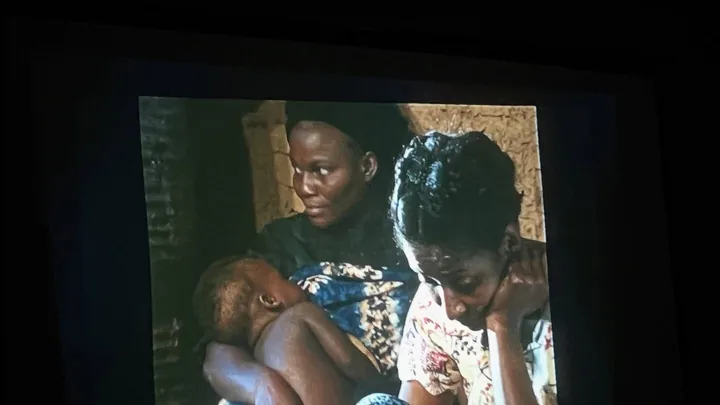
Rete: For me, many times over. Something depicted on screen can feel like it was written for you, like an answer to a question you’ve been sitting with over and over again.
One that really moved me: my first time ever experiencing a film festival in Lagos, I was at S16, and they were screening This Is Not a Burial, It’s a Resurrection. I’d heard about it while it was still in development, back when I was in university, and thought, this sounds like such a beautiful project. When I finally watched it, seeing that depiction of southern Africa, it was nothing like what I’d imagined was possible. For the longest time I’d felt like certain stories just couldn’t be told here, that our environments weren’t “cinematic” in that way, and then you watch something like that and you’re completely blown away. I left that cinema so motivated to make films myself. It genuinely changed the trajectory of my professional life. Cinema can completely reframe your experiences and be the lens through which you view the world.
It’s not always that serious either. I watched I Am Not Your Negro in secondary school and it completely reframed how I understood blackness and African identity. But I’ve also cried real tears watching the Lion King. Mufasa, rest in peace, they did that man so dirty. It’s all the same muscle. Even a TikTok can hit you the same way sometimes. That’s really just an extension of moving image.
Ife: Looking at this year specifically, our programme in July and in May. In May we showed Dika Ofoma’s Obi Is a Boy and Rue Princesse. It was so packed we had to run back-to-back weekends. What I could see, with returning faces, as recently as this past Saturday, is that people really, really care. They’re looking for a space to say, every month I’m going to show up, watch a film, discuss it, learn from other people. We reach over 500 people across our cities every month. We also had a weekly programme at London Performance Studios in April, showing African films to an international audience, people who’d never seen those films or met the people who made them. It proved just how potent the cinematic language is in bringing people together.
Zainab: Recently when we screened Mothers of Chibok, it was a deeply moving, heart-wrenching experience about Borno State, and a lot of women were in the audience that night, so there was this real, shared empathy for what these people had been through, as a group. My guest curator at the time, Fawziyya, and I were both just as affected as the audience was. We had the director do a Q&A afterwards, and we got to ask him how he’d navigated making that kind of film in a very sensitive moment. A lot of the films we show are personally inspiring: they inspire us and our audiences to empathize with other people’s experiences and think differently.
Do conversations differ when screening older African films versus newer ones?
Ife: Older films show that issues African countries dealt with in colonial times persist in new, sinister ways today. We screened Dahomey recently, and people weren’t just talking about “oh, we were kings.” They were actually grappling with what it means to exist with dignity now, as a continuation of that past rather than a nostalgic look back at it. When we paired Colette & Justine with a Biafran War short by Olisa Eloka, people drew direct links to contemporary Nigerian society, even though neither film was really “about” the present. Restoring and giving new life to obscure African films matters because they are urgent historical time capsules that help us make sense of our present and plot a future.
Rete: We try to make sure there’s a clear through line connecting the films we’re presenting, two generations, decades apart, approaching the same questions. It’s nice seeing that contrast, and still being able to draw a line between them.
Could you describe the nature of your partnerships, beyond just providing space?
Ife: What links us all is creating a community for filmmakers to present work and film lovers to engage critically.
We realised early that this can never be a solitary endeavour: you need partners, you need a community to support it, that’s what makes it sustainable. We’ll be two years old this November, and the only reason we’ve lasted this long is the people around us. A lot of alternative spaces in Lagos run for six months and disappear. Being nomadic actually helps with that: if a partnership ends, we can go find another space, because the work we’ve already done gets us in the door elsewhere. Showing up consistently, every single month, is what lets that keep happening.
The curators
Zainab, how did you get into building such an insane film library?
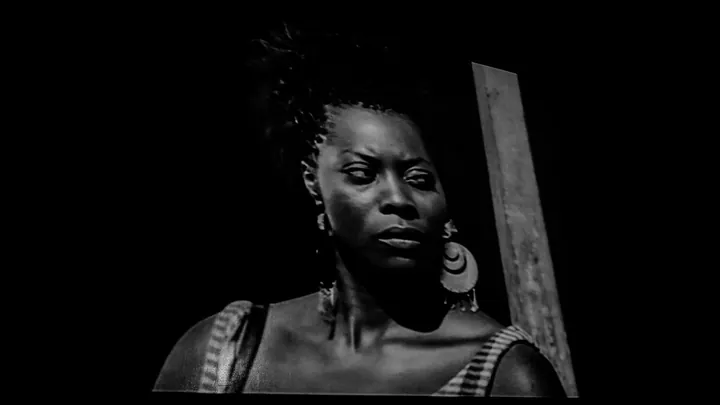
Zainab: Watching movies was always a hobby, and Twitter became a place to share what I watched. Because I had access to a lot of the places I was sourcing films from, I started sharing them more widely, and at some point people started taking it seriously. When I noticed many classic or rare African films lacked subtitles, I decided to learn subtitling software and started creating subtitles myself for public platforms, around a year before this. It’s become a small personal project I do sometimes, and it’s been really rewarding. Filmmakers have asked me to help subtitle their own work too. Honestly, I enjoy it because it forces me to slow down and really sit with a film, sometimes watching it over and over. I make it a mission to share older African films so people get a glimpse of our history, culture, and civilisations.
SIT bridges the accessibility part. Instead of just sharing a Twitter thread online, we can bring people into a physical space to watch, discuss, and engage with those films together. See Zainab’s crazy library!
Rete, could you talk about your film Traces of the Sun?
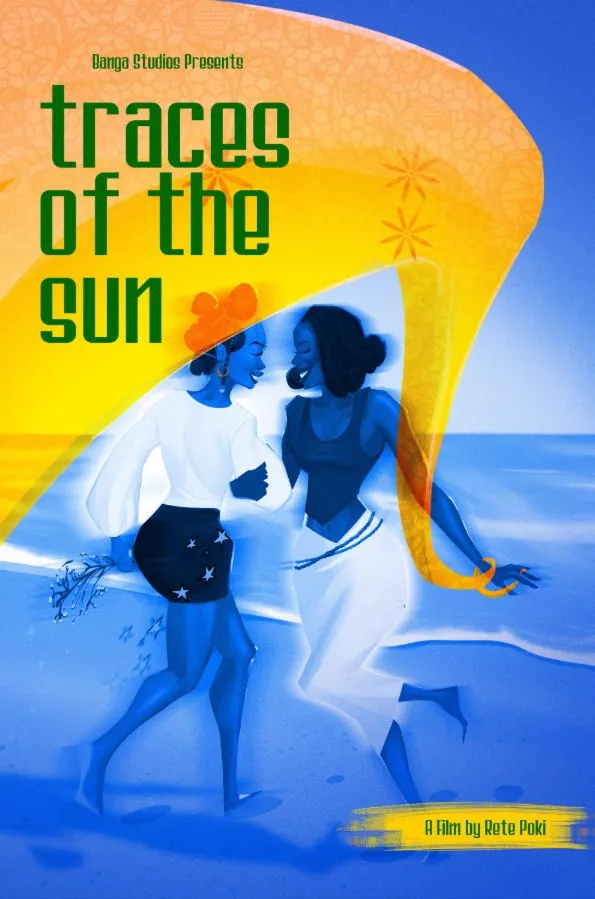
Rete: Traces of the Sun is an essay film exploring the different ways Nigerians understand love, through family, through romantic relations, through the platonic. What does it mean to a Nigerian, how is it expressed, how is it understood. For about six months, I interviewed different people I knew, and strangers, a series of questions about what love means to them, stories they’ve had with their siblings, lovers, parents. I was trying to understand how Nigeria shapes our perspective toward intimacy, safety, security, and what steps we might take to change some of those patterns. After a few months of that, I began creating little scenes inspired by the responses, and over time put those together into one film.
Ife, you wrote an essay about Sudanese cinema’s revival after years of suppression. Why does restoring and making these films available now matter?
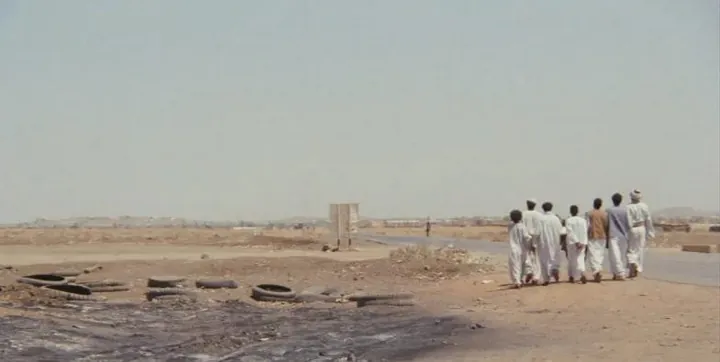
Ife: Film is part of our history in the same way any other cultural record is. A film made in a particular period carries the social, political and economic conditions of that moment: it’s a response to the society it came out of. I think about this with music too: the psychedelic rock and funk, the Afrobeat and highlife that came out of Nigeria after the war, is itself a colonial inheritance. You find the same imprint of that kind of imperial aftermath in places like Zimbabwe, Ghana, the DRC: different expressions, but similar roots, and those different sensibilities eventually coalesce into something new altogether.
It’s not nostalgia. Understanding the present, and plotting toward a future, requires reckoning with the past in all its complexity, and that’s why restoring and resurfacing these films matters now. Read the essay on Shado Mag!
Amanda, describe your film A Body in Metaphor, which came out of the Post-Memory Post-Archive project.
Amanda: A Body in Metaphor is an essay-style documentary exploring how the female body has been rendered across African cinema. It looks at how even veteran, celebrated filmmakers had this blind spot around the female body, often using it passively, as a prop, or for shock value, and pushes toward a more careful, intentional look at how we as filmmakers use the body on screen. It came directly out of PMPA; I was one of the beneficiaries of that workshop, spent a week with other filmmakers and researchers digging through the archives, and that’s where the film started. PMPA taught me that even if the African film canon is fragile, we have to be willing to interrogate and critique it: that’s what makes the craft better, continent-wide. It came out last August.
Did making it change how you curate for SIT?
Amanda: Definitely. Now there’s a meter in my head constantly gauging whether a depiction of the female body is necessary or if it’s being used passively. I can’t shut that part of me off.
How does SIT fit into your own personal mission for film, beyond what it does as a collective?
Ife: Programming felt like a responsibility I had to take charge of. When I came into film, I was interested in writing and making films, but programming is something I’ve grown into, and now it’s a big centrepiece, creating community and opportunity for alternative cinema. Most people right now know me as a programmer. It’s supported my other work in ways that aren’t always obvious: cultivating community, bringing people into the room that I’ll work with down the line, teaching me admin work, managing people, applying for grants, giving me access to rooms that might have been difficult to reach as just a filmmaker.
Amanda: For me, film has never just been about watching stories unfold on a screen. I’m interested in what images do after we encounter them, what they teach us to remember, what they make visible, and sometimes what they allow us to ignore. A lot of my own work sits around memory, archives, representation and the ways we make sense of difficult realities and perceived realities.
SIT fits naturally into that. It gives me a way to move those questions outside of research or individual filmmaking and into a public space. I’m interested in film as a way of gathering people around difficult conversations, particularly conversations around personal, national trauma, power, belonging and collective memory. For me, the screening is only one part of the experience, what happens in the room afterwards matters just as much.
So beyond SIT as a collective, it connects to a larger personal mission of thinking about film as a form of public memory and a space for reflection. I want to make, curate and support films that leave people with questions they continue carrying long after the screen goes dark.
Favourite screening so far?
Zainab: My favourite screening so far was the one where we showed Karmen Gei and the film by Marlon Riggs, that queer-themed month. I’m torn between that and the one we had in May where we showed Rue Princesse and the film Obi is a boy.
Ife: In recent memory, our January 2026 programme, showing Amanda’s film, was really great, as were April and July. But my favourite is still our very first screening, in Lagos. There were only about 7 of us, and by the end only 4 left. A new close friend, Belinda, came randomly after seeing it on her Explore page. Realising The Screen in Transit would extend beyond my immediate friend group was surreal.
Amanda: It’s honestly tough to pick a favourite because every time I think I’ve found one, another screening comes along and leaves a lasting impression in a completely different way.
Where can people find out about screenings?
Ife: Readers can sign up for our mailing list on our website, designed by my friend Mina. You can also find us at @thescreenintransit on Instagram, @screenintransit on Twitter/X, and our Substack, where you can read all our essays. Once you’re on the mailing list, you get personalised emails every month telling you what we’ve done and where the next screening will be. By two weeks into a month, tickets are up for all four locations: Lagos, Abuja, Kaduna, and Benin.
All right, thanks for talking to me!
Rete, Zainab, Ife, Amanda: Thank you!
Interviewed & written by Soala Iyalla