Tour Editorial · 23 October 2026
Icaross Is Burning His Hands on the Canvas
A Conversation with Icaross
By Tour Editorial and Soala Iyalla6 minute read
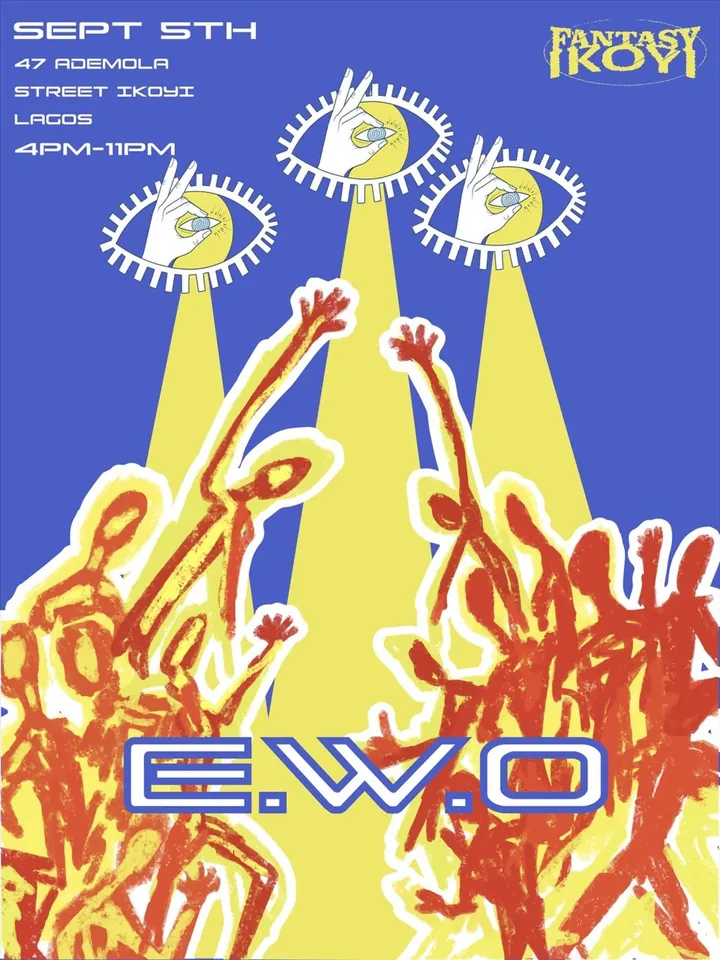
On a sunny Thursday afternoon in September, while touring the creative house Fantasy Ikoyi, I met Icaross. He came through the large doors and welcomed us, and I recognised him from the research I’d done on the space. I knew he was an artist, that a few of the pieces on the walls were his, and that he’d curated a couple of exhibitions there in the past months, among them Eyes Wide Open. I knew he worked with Fantasy Ikoyi in some capacity, perhaps as an in-house artist or curator. But what came back to me most vividly were the evocative stories and language threaded through his first solo exhibition in Lagos, You’ll Burn Your Hands, and the name Icaross itself, a portmanteau of the Greek myth of Icarus and his own.
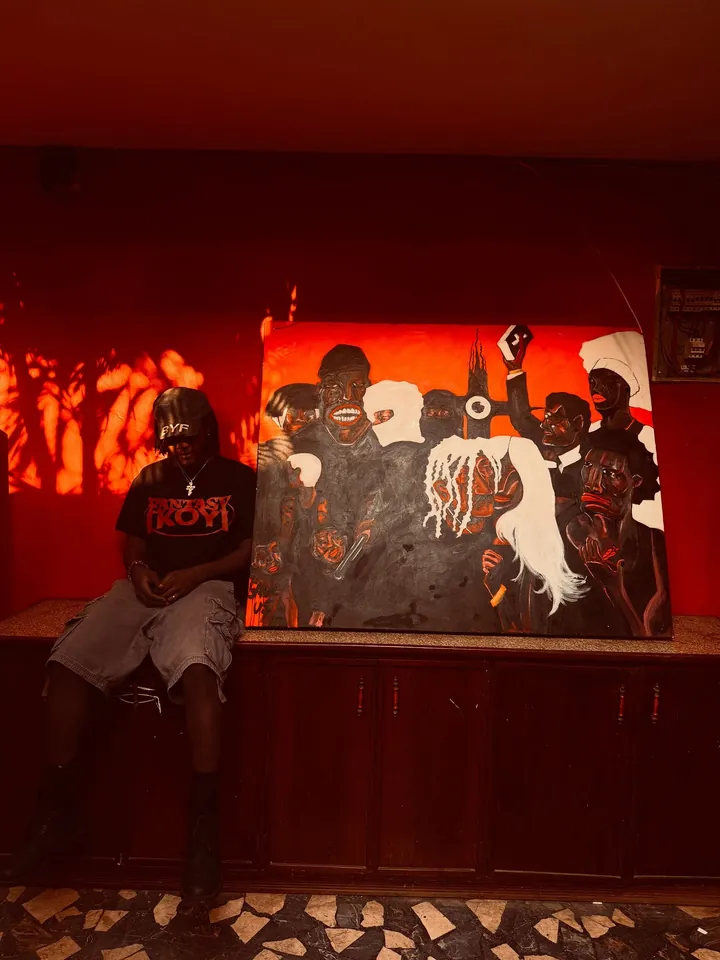
I couldn’t resist. So when the chance presented itself, I kidnapped him from his work. And sitting against the backdrop of his painting, Debauchery of Your Soul, mounted on a glass block wall, we had this brief and delightful conversation.
How did you get into painting?
I was in my first year of uni and I was very depressed. I had problems making friends. I was used to being around my siblings, and now I was living with people I barely knew, and it wasn’t going how I wanted it to. Painting kind of filled that space of human interaction. I didn’t have money to buy materials, so I used to paint on the same canvas over and over. One canvas had up to a hundred paintings on it by the time I was done; I just kept layering until it was so thick at the end. But that’s how I learned. Nobody ever starts off good. You start off horribly, and you keep going until eventually you become something. That’s just how it works.
Did you have any influences?
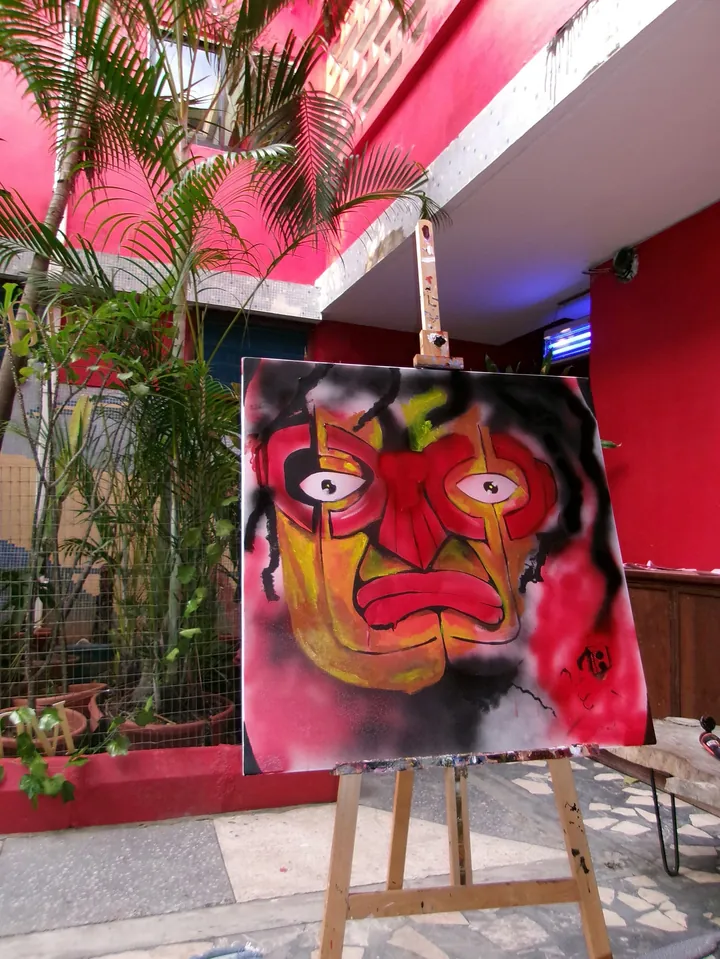
I used to be a very big art fan. I had posters (which is kind of illegal, to be fair, taking people’s work without permission and sticking it on your wall), but I just loved this artist called Blake Hubert. He did this ice thing, and I was obsessed, telling everyone, “This guy is out of his mind.” I had about thirty of his pieces up on my walls, and people would walk in and be shocked. I had that kind of interest. When I first started painting, I kind of mimicked him, because that’s just how it starts: you need someone to imitate before you can come up with your own story.
Tell me about the name Icaross.
Icarus is the character who tried to fly too high, to touch the sun, even though he wasn’t meant to go that far. I took that myth into my own life. When I came back to Nigeria, I didn’t know anybody but myself, and people kept telling me I couldn’t achieve what I wanted. I didn’t know the right people, didn’t have the connections, didn’t have this or that. And I was like, no, I have it in my own mind. I know the work I’m putting into my craft is going to show. I gave Tayo a painting, and six months later he called to ask how my exhibition was coming along, and bam, I had an exhibition. The name carries that same idea: I never agreed to fly only as high as people expected me to. My exhibition was called You’ll Burn Your Hands, meaning even if touching the sun burns you, you still touch it. Always try to achieve more than you set out to. And even when Icarus was falling, he was laughing. He didn’t regret flying high.
You mentioned painting became a kind of therapy for you.
When I was in high school, I got bullied a lot, and those things followed me into adulthood. I’d be in relationships and people would say certain things about me, and I’d believe them, because I already felt like the person, the monster, I’d been told I was growing up. Painting myself in an honest, sometimes exaggerated form, putting in things I find interesting, helped me accept myself. It became a kind of therapy: the character I paint is, in a sense, me. Things I wanted to do as a child, I get to do through the painting. I’m painting my inner child.
What role did your father play in this?
My dad was a huge supporter of me being an artist. When he passed away, I was about sixteen, and I decided I wasn’t going to pursue it anymore. I went and studied psychology instead, and didn’t paint or draw for about six years. Then I had a dream about him, and in it he told me that the things I was scared of doing were the reason I hadn’t made it yet. After that dream, I just went back to painting. There was a piece I made at home called Roots, based on something I saw in that dream. It got damaged when I was moving houses, so I painted over it, and from a distance, the new painting looked like my father. I added his moustache, because he always had one, and suddenly I was just looking at him. The painting named itself. My sister won’t let anyone else have it; she wants it to stay in the family. I’m happy about that, because it’s one of the only times I’ve ever painted my father.
What’s your process like?
I can sit and paint for eight hours straight. Most of the work from my first exhibition was made over two months, but two of the pieces came together in two weeks. When I’m painting, I have all those hours to think. At some point it becomes automatic, your hands just do what they need to do while your mind keeps working. It lets me go through my life, study my mistakes, and also recognise that I’m doing my best as a human being. It’s therapy. That’s why I think everybody should paint, not because everyone needs to be an artist, but because it gives you hours to actually think, instead of just moving full speed through life without living in the moment.
There are a lot of talented people in Nigeria; it just comes down to how they present themselves. I try to create events with artists I respect and bring the spotlight to them. I’m still learning, about art and about the stories behind it, and about how to pull a viewer’s attention toward things they wouldn’t otherwise care about, including the conversation that artists deserve protection and support, from government and from the people around them.
What’s the art scene like in Lagos?
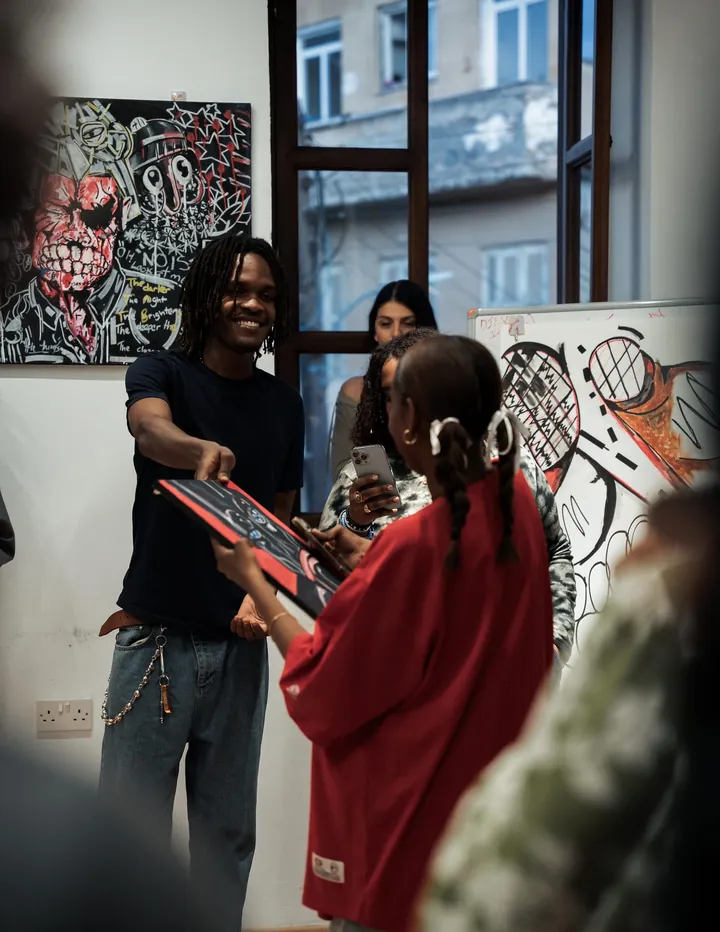
The Lagos art scene itself is wonderful, honestly. Last week we had an exhibition I curated, Eyes Wide Open, running the same day as another show, Wake Up, by an artist called Y2K Princess. That’s new. Before, you’d only get one of these in a month, maybe every few months. Now artists are organising themselves, building markets, building foundations for each other. That’s why Fantasy is so important: it gives artists a place to actually feel at home, with their work mounted permanently. Musicians come through and ask who made this or that. We’re trying to pull younger people further into art, even just as supporters, everybody should have at least one artist whose work they follow.
I’ve always been a fan of art: other people’s, and sometimes my own, to be fair. When I notice something that could help an artist, or something holding them back from the attention they deserve, I give advice, and I try to connect them with the right people. The mistake most artists make is wanting to do it alone, because they want to be the one who “made it.” But if there’s a community to come back to, you know you’re not just working in your room; you’re part of something that has already produced wonderful artists. That’s already happening, honestly, even without me. I’m just trying to make it happen faster.
Any closing message?
Paint. Just paint, anything. Don’t overthink it. My advice: get a canvas, cover it in a hundred paintings, and then give it to a friend. But paint. It helps with mental health, and it helps with productivity. Whatever you’re carrying from your past comes out in the work.
Interviewed & Written by Soala Iyalla